Showing posts with label 5000m. Show all posts

Friday, June 15, 2007

Incredible New World Record by Defar!

(photo courtesy of www.bislettgames.com)
At the ExxonMobil Bislett Games in Oslo, Norway, Meseret Defar of Ethiopia smashed her own world record of 14:24.53 in the women's 5000m run by 7.90 seconds with an incredible 14:16.63. Kenya's Vivian Cheruiyot also dipped under the record with a time of 14:22.51. In a post-race interview Defar said she expects to run a 14:10 in the future.

Osafa Powell of Jamaica won the men's 100m in a time of 9.94, the 2nd fastest 100m in the world this year, Powell's time is only 1/100th of a second behind Walter Dix' 2007 world-best time of 9.93. For complete results and news, visit the Bislett Games website here.

Tuesday, May 29, 2007

Asafa Opens Season with Sub 10 in Belgrade

Jamaican Asafa Powell proved that his knee tendonitis is healed by winning the men's 100m dash at the Artur Takac Memorial meet in Belgrade, Serbia. Powell's season-opening mark of 9.97 overtakes Bahamanian Derrick Atkins' world-best of 9.98 and nudges him to the top of the list.

Kenya's Moses Masai won the men's 5000m run at the same meet, running a world-leading 13:08.80. Masai's time surpasses Mexican Juan Luis Barrios' time of 13:11.37. Countryman Hosea Macharynyang also dipped under Barrios' world-leading time with a 13:09.83.

Jolanda Ceplak of Slovenia won the women's 800m as expected, clocking a 2:00.92, a meet record. Wilfred Bungei of Kenya handily won the men's 800m by 1.04 seconds, winning in 1:45.50.

Complete Results for the meet can be found here.

Monday, May 28, 2007

Some Track History On the Web

I love finding nuggets on the web like this classic video of Emil Zatopek's gutsy come-from-behind win in the 1952 Olympic 5000m. If you've never watched him run, check out that exaggerated head roll for which he was famous. Here's a vivid description of the end of that awe-inspiring race (in the section titled "The Nickel, the Dime, and the Big One"). Also watch for Great Britain's unlucky Chris Chataway (who would help pace Roger Bannister 2 years later to the first sub 4 mile in history) as he trips and falls with 150m to go in the race, thus losing out on a medal. Ouch! That's cinder! He did get up and finish the race in 5th place (you might not know that Chataway had a hand in the creation of the Guinness Book of World Records):


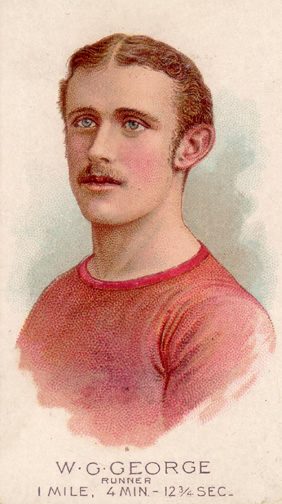
Check out these vintage photos, including this one of professional runner Walter G. George, who in 1886 ran the mile in 4:12.75, a world record that stood until 1915, when amateur Norman Taber ran a 4:12 3/5:
This website dedicated to Alfie Shrubb, a British runner who dominated middle-distance events in the early 1900s, is an interesting peak into the early days of middle-distance running, when races were held at all kinds of unusual distances, including 1.75 miles and 4000 yards:


Okay, one more. Here's some footage of Bob Beamon's world-record long jump in the 1968 Olympics in Mexico City. He jumped so much further than ever before, the official measuring device wasn't long enough to measure the results! I still love watching that incredulous look on Beamon's face mid-jump and his unbridled display of joy and disbelief after he heard the official result of 8.90m (29' 2 1/2"). The looks on the officials' faces are priceless, too, when Beamon composes himself after his celebration and goes around shaking all of their hands:

Saturday, May 26, 2007

Bekele's Knee Okay, Some World's Bests, Dix Breaks NCAA Record

You might recall that Ethiopia's Kenenisa Bekele has been worried about his strength and a knee injury lately. He may have put those worries to rest with his 8:13.51 win in the 2 mile run at Hengelo, Holland today. Bekele's performance was the 27th fastest of all time, proving that Bekele is healthy again. Other notable performances today in Hengele:

Ethiopia's Gelete Burika ran a world-leading 14:38:18 in the women's 5000m.

Kenya's Paul Kipsiele Koech ran a 8:01:05 in the men's 300m Steeplechase, another world-leading time.

Panama's Irving Saladino tied his world-leading 5.83m mark in the long jump.

Ethiopia's Sileshi Shihine ran a world-leading 26:48:73 in the men's 10000m. In that race, Haile “Mr. Hengelo” Gebrselassie broke 27 minutes to finish in 5th place with a time of 26:52.81. Not bad for a retired guy.

Florida State's Walter Dix arrived on the world stage today at the NCAA East Regional meet in Gainesville, FL, breaking the NCAA record of 19.75 by winning the 200m dash in a time of 19.69. His performance today marks the seventh fastest men's 200m dash of all time. Dix also won the 100m dash in 10.05 and helped his FSU team win the 4x100m in 38.71.

Monday, May 21, 2007

Bad News about Bekele

Ethiopia's Kenenisa Bekele still has not recovered from his disastrous race at the World Cross-Country Championships in Mombasa this past March. Elias Makori of the Daily Nation Online (registration required) reports that Bekele claims he has "no power any more," with feelings of dizziness, muscle weakness and knee pain.

According to the spokesman for the Ethiopian Athletics Federation, Elshadai Negash, Bekele plans on testing his racing form in Hengelo, Netherlands, this Saturday before seeking further treatment. Bekele will compete in the 2 mile run at the THALES FBK-Games, an IAAF Grand Prix meet.

Depending on how this Saturday's race goes, Bekele is planning on running next at the World Championships' 10000m to defend his world title. He has not made a decision about whether or not to double in the 5000m. After Osaka, he plans on running only 3 more races, according to Makori. He usually runs about 16 races in a year. This year his total will only be 5 meets. Let's hope the additional rest will allow time for Bekele's full recuperation. If not, the men's 10000m at the World Championships will be seriously diminished.

In other news, Tyson Gay and Allyson Felix top the standings in the Visa Championship Series with their wins at the adidas Track Classic. Next stop for the series: the Reebok Grand Prix on June 2nd in New York City.

Sunday, May 20, 2007

Is Galen Rupp Ready for the International Stage?

This afternoon I finally had a chance to watch the tape delay of the PAC 10 Track and Field Championships I tivoed last night (hmm... a tivo delay of a tape delay. I thought technology was supposed to speed things up?). Tom Feuer, the FSN announcer who (along with the ubiquitous Dwight Stones) did the color commentary for the broadcast. Feuer seems to think that Galen Rupp, the 21 year old distance-running phenom from the University of Oregon, is ready to break into the international running scene with his 5000m win at the Pac 10 meet. The proof? A 2:02.7 last 800m and a 61.6 last lap that left Arizona's Obed Mutanya some 15 meters back at the tape.

Mutanya challenged with some 150m to go, but Rupp easily held him off and pulled away to add 10 more points (he also won the 10000m) to the Oregon men's team victory. Impressive win, to be sure, but a 14:02 is a long way from a 12:50 Rupp will need to compete on the European circuit. Rupp's PR, set on April 20th, is a 13:30.49. That's not too shabby for a 21 year old but it's still 19 seconds off Juan Luis Barrios' world-leading time of 13:11.37. In fact, Rupp is only the 8th ranked American 5000m runner right now and 20th in the world.

Rupp is sure to rank among the world's top distance runners with a couple more years of seasoning. Right now, though, he needs to extend that incipient kick of his out to about 4 laps at a 60 second per lap pace. Otherwise, he's going to suffer the same fate that other 21 year old Oregon phenom, Steve Prefontaine, suffered at the hands (or should I say feet?) of Lasse Viren, Mohamed Gamoudi and Ian Stewart in the 1972 Olympic 5000m final. In that race, Pre ran his three next-to-last laps in 62.5, 61.5 and 60.3. He was with the leaders at the bell lap but Viren ran the last lap in 55.8 to win in 13:26.4 to Pre's 13:28.3 4th place finish. Nowadays, the last lap of a world-class 5000m race is usually even faster than that. There's a good lesson to be learned from that race. Hopefully Rupp has watched it:


I would love to see the American distance runners take center stage again at the world level. Rupp's not quite ready to do that, although he certainly could be in a couple of years.

Tuesday, May 15, 2007

Peaking for Middle-Distance Races

At this point in the season many athletes are peaking for their championship races. How is this done? Peaking for a middle-distance race (800m, 1500m, 1600m, mile, 3000m, 3200m, 2 miles or 5000m) is best done by utilizing a training method called tapering.

Tapering, in essence, involves the increasing of leg-muscle strength by gradually reducing mileage by 50% over a two week period while continuing to perform speed work. During the taper period, the percentage of speed work should remain consistent with the percentage of speed work that was done prior to the beginning of the tapering period. In other words, if you ran 10% of your mileage as speedwork before you began tapering, you should continue to run 10% of your mileage as speedwork while you are tapering. Taper training produces considerable increases in muscle glycogen concentrations, total blood volume, red blood cell mass, and oxidative enzyme activity, all important factors in improving race times for middle distance races.

Here is the tapering program in bullets:

  • Begin tapering 17 days before race day. Remember that tapering involves physiological changes in the way your body adapts to the reduction in workload, so you may experience sluggishness. Don't worry, this is normal. By race day you should be rearing to go!
  • For week 1 of taper training, drop your overall mileage by 25% but continue your speed training for 10% of your new, reduced mileage.
  • For week 2 of taper training, drop your overall mileage by another 25% while continuing your speed training for 10% of your new, reduced mileage.
  • Speed training should consist of short distances with long rest intervals (rest 5 times as long as the repetition). How fast? 2 seconds per 200m or 4 seconds per 400m faster than 5K race pace. Don't overdo it. Your hardest training should be behind you.
  • Prepare mentally while you are tapering. Visualize yourself as rested, well-prepared, fast and ready to win the race!
  • Remember to reduce calorie intake as you reduce mileage. Let's say you weigh 150 pounds. You burn approx. 100 calories per mile. If you averaged 50 miles per week before tapering, you will run a total of 37.5 less miles (and burn 3750 less calories) during your two-week tapering period. If you continue to consume the same amount of calories as you did during the pre-tapering period, you will have gained over 1 lb. by race day (3500 calories = 1 lb.). Gaining weight will slow you down on race day.
  • 3 days before race day: begin light jogging for 2 days.
  • Rest completely the day before the race.
  • Run your peak time!

[Source]

Here's a video of a man who really knew how to use tapering to his advantage. Sebastian Coe ran a world record of 1:41.73 in this 1981 800m race.

Ageless Yifter the Shifter

Legendary Olympian Miruts Yifter turns 63 today. Or maybe he turned 69 back on January 1st. Nobody really knows, maybe not even Yifter. Regardless, his gold medals in both the 5000m and 10000m at the 1980 Moscow Olympics are still quite an accomplishment for a man who was 36 at the time (or was he 42)?

Finish Line Pundit Archives